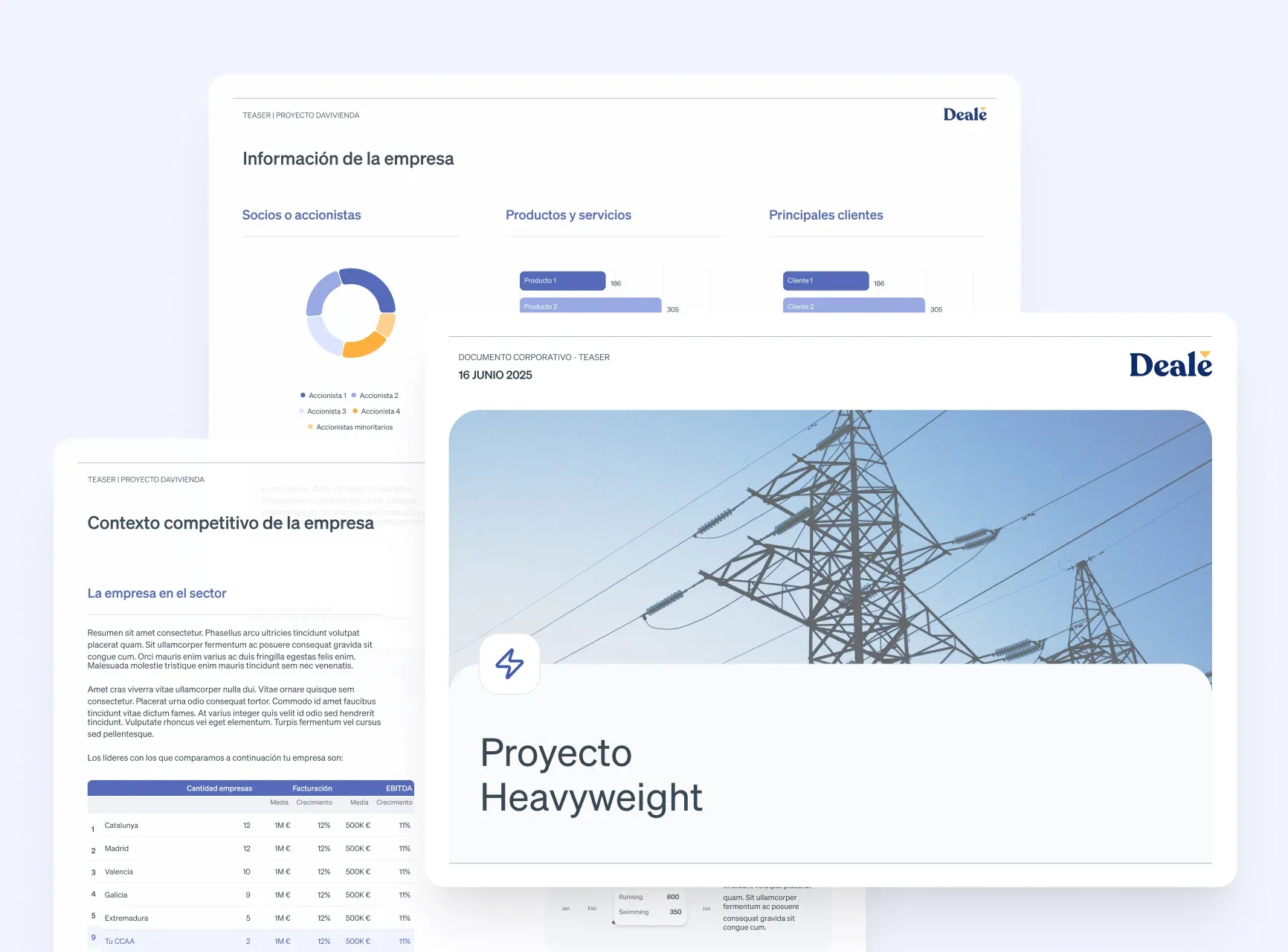
When business owners decide to sell their company, there's one document that marks the turning point in the process: the information memorandum. It isn't just any administrative memo — it's the first detailed snapshot potential buyers receive after signing the non-disclosure agreement, and how many offers the deal attracts, and at what valuation, depends to a large extent on its quality.
In this article, we explain exactly what an information memorandum (IM) is, what sets it apart from the teaser, what it should contain, and who should prepare it.
What is an information memorandum?
The information memorandum (IM), also known as a confidential information memorandum (CIM), info memo or, in Spanish, cuaderno de venta, is the confidential document that the seller —usually through its M&A advisor— provides to potential buyers who have shown interest after reviewing the teaser and signing a non-disclosure agreement (NDA).
Its goal is to present the company in a thorough but structured way, giving potential investors the information they need to make a well-founded non-binding offer.
A good IM:
- Generates interest and positions the asset in the market
- Anticipates the key questions buyers will ask
- Sets the professional tone of the process
- Reduces the back-and-forth of information in later stages
A note on terminology. The term "memorandum" is also used for internal administrative memos within companies and for legal documents such as the memorandum of understanding (MoU). In the context of mergers and acquisitions, however, "information memorandum" has a very specific, well-defined meaning, which is the one we cover in this article.
IM vs. teaser: how they differ
One of the most common questions is the difference between the teaser and the information memorandum. Both are sell-side marketing documents, but they serve different purposes and are delivered at different points in the process.
In practice, the document flow in an M&A deal is:
Teaser → NDA → Information memorandum → LOI → Due diligence → SPA → Closing
What should an information memorandum contain?
Although every deal has its own particularities, a well-built IM is usually structured around these sections:
1. Executive summary. The synthesis of the document: business description, key financial figures, value proposition for the buyer, and deal rationale. It's the most-read section and the one that has to hook the reader.
2. Company description. History, corporate structure, current shareholders, locations, subsidiaries, and organizational chart. Everything that defines what the company is today.
3. Product, service, and business model. Catalog, value proposition, sales cycle, recurrence, pricing policy, and competitive advantages.
4. Market and competition. Market size and growth, segmentation, competitive analysis, and the company's positioning within the industry.
5. Customers and channels. Customer concentration, breakdown by geography or segment, sales channels, and relevant success stories.
6. Operations and suppliers. Production processes, installed capacity, logistics dependencies, certifications, and main suppliers.
7. Management team. Track record of key executives, operating organizational chart, and post-deal continuity plan.
8. Financial information. Audited accounts for the last 3–5 fiscal years, trends in EBITDA and margins, working capital, investments, and debt. It usually also includes 3–5-year projections with explicit assumptions.
9. Rationale and indicative valuation. Why the deal makes sense, potential synergies, growth levers and, sometimes, an indication of benchmark multiples without going as far as setting a price.
10. Process and timeline. How the competitive process will be structured, key dates, and the expected format of offers.
The practical perspective: what makes a good IM
After hundreds of deals, the IMs that generate the most LOIs share a few traits:
- Honesty about weaknesses. Hiding customer concentration or a drop in margin doesn't work — it will come out in due diligence and erode trust. It's better to anticipate it and explain the mitigation plan.
- Defensible projections. The buyer will apply a discounted cash flow analysis or multiples to the figures in the IM. If the projections don't hold up under questioning, the valuation is adjusted downward.
- Professional design. It isn't an academic report — it's a marketing document. Careful layout, readable charts, and consistent data across sections.
- Consistent financial information. Discrepancies between the executive summary and the financial section are an immediate red flag for buy-side advisors.
In terms of timing, preparing a high-quality IM usually takes 4 to 8 weeks, depending on the state of the company's financial information and the complexity of the business.
Who prepares it? Almost always a specialized M&A advisor (investment bank, financial boutique, or M&A broker) working closely with the company's management team and finance department. Doing it in-house is possible but risky: the IM also works as a test of the process's professionalism, and institutional buyers notice.
Thinking about selling your business?
Preparing a solid information memorandum is one of the steps with the greatest impact on the final outcome of a sale.
At Deale, we support business owners and executives throughout the entire process, from the initial valuation to closing.
Talk to our team and start preparing the sale of your business →