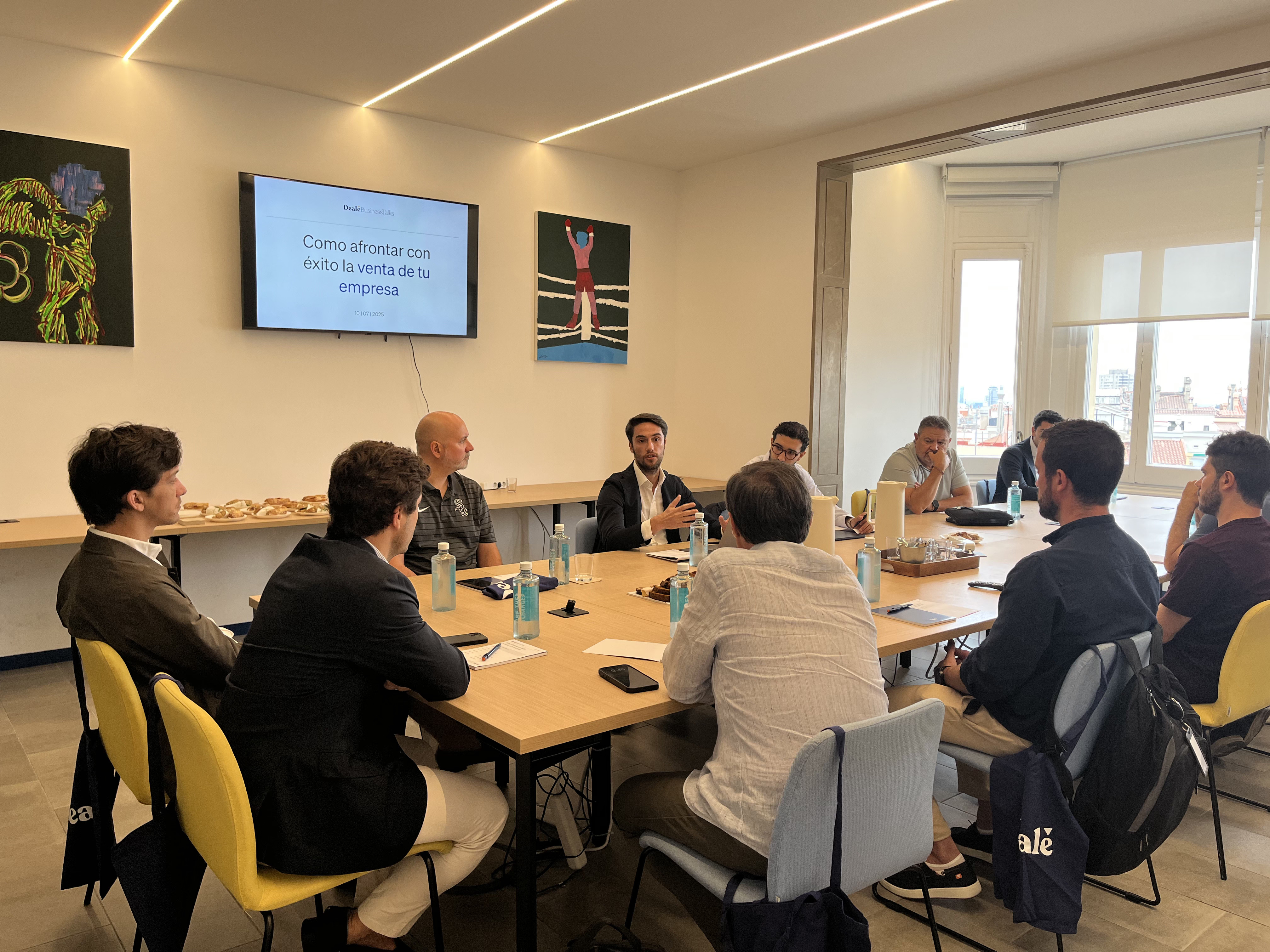
On July 10, we held the second edition of Deale Business Talks, an event designed to bring the process of buying and selling businesses closer to those who are considering selling their company or have already started receiving interest from potential buyers.
This time, we wanted to go beyond talking about valuations or market trends and focus on a much more practical question: What really happens when an investor shows interest and the deal starts moving forward?
Because receiving an offer or starting conversations with a buyer is just the beginning. On the way to closing, there are stages many business owners don't know in detail — the letter of intent, exclusivity, due diligence, negotiating the payment structure, signing the purchase agreement — and coming prepared to each one can make the difference between completing the deal and watching it fall through in its final stages.
Date
Organised by


Oriol Ferran
Co-Founder and Director at Deale
One of the main messages of the session was the importance of preparation. At Deale, we see deals that get very far along but end up falling through over issues that could have been addressed earlier: incomplete documentation, a lack of understanding of how a transaction works, very different expectations between buyer and seller, or clauses that weren't negotiated properly.
Before starting a sale process, it's worth understanding not only what the company might be worth, but also what a buyer will require during the process and what decisions the seller will have to make as the negotiation progresses. If you'd like a practical reference on how to prepare for those first conversations, we've published a guide on the 6 keys to preparing your SME before meeting with buyers.
During the panel discussion, the business owners in attendance were able to share where they stood, the reasons that had led them to consider a deal, and the challenges they had faced so far.
The letter of intent (LOI) is usually one of the first major milestones in a transaction. Up to that point, there may have been meetings, information exchanges, and preliminary conversations, but the LOI is the document that starts to set out the terms under which buyer and seller would be willing to move forward.
During the event, we discussed what receiving an LOI involves, which aspects can be negotiated, and what agreeing to an exclusivity period means. Granting exclusivity means, in practice, stopping negotiations with other potential buyers for a set period so that one of them can analyze the company in more depth and move toward closing. Fully understanding what you're agreeing to, for how long, and under what conditions is essential before entering this stage.
After the LOI usually comes one of the most intense moments of the process: due diligence. The buyer needs to verify that the company's reality matches the information on which they built their offer, and to do so they'll analyze financial, tax, corporate, employment, commercial, and operational documentation.
A well-prepared company can go through this stage in an orderly, efficient way. On the other hand, incomplete documentation, contradictory information, or unanticipated risks can slow the deal down, trigger new negotiations, or lead the buyer to reconsider the terms initially proposed.
One of the practical conclusions of the session was that preparing for a sale also means having the company's information organized before anyone asks for it. When a buyer requests documentation during due diligence, the speed and quality of the response convey professionalism — and that has a direct effect on the buyer's confidence and on how the subsequent negotiation unfolds.
Another topic that sparked a lot of conversation during the session was the payment structure of an acquisition. When business owners hear that their company has been valued at a certain amount, they may assume they'll receive the full amount at signing. However, most deals in the Spanish mid-market are structured by combining several mechanisms.
The upfront payment is received at closing and usually represents the bulk of the price. The deferred payment spreads part of the price over later installments, sometimes with additional protections. And the earn-out ties part of the price to meeting certain future targets — typically revenue or EBITDA — over an agreed period.
These structures allow risk to be shared between buyer and seller and, in many cases, make it possible for both sides to reach an agreement that wouldn't have been reached with 100% at closing. The challenge lies in understanding what each formula involves and properly negotiating the timelines, the conditions, and the seller's real ability to influence the metrics that will determine the future payment.
Selling a company means accepting that the buyer needs to protect itself against certain risks, but that doesn't mean all of its demands should be accepted without question.
During the panel discussion, we covered what it's reasonable for a buyer to ask for and where the seller should set limits. Negotiation isn't just about agreeing on a price. It also involves warranties, future liabilities, payment terms, the owner's continued involvement in the company, how the business operates during the process, and post-closing commitments. Some of these clauses can keep having effects long after the sale is signed — and understanding them before agreeing to them is essential.
For a detailed analysis of the clauses that leave the seller most exposed in a purchase agreement, we've published an article on the 8 most sensitive SPA clauses.
The final stage comes with the negotiation and signing of the share purchase agreement (SPA), the contract that definitively governs the sale. It's the document that formalizes the price, the form of payment, the parties' warranties, and the obligations that must be met before and after closing.
During the event, we reviewed how the deal gets to this point and what mechanisms exist — such as escrow — to ensure that payment and the transfer of the company take place as agreed. After months of conversations, analysis, and negotiation, this is where the deal goes from paper to reality.
Another important point of the session was the seller's role once the acquisition is complete. Depending on the type of buyer and the company's situation, the former owner may stay on for a set period to ease the transition, hand over customer relationships, support the new management team, or preserve key knowledge that isn't yet documented.
A sale in which the business owner wants to step away immediately is not the same as a transaction where buyer and seller agree to work together for one or more years. It's an issue worth addressing from the earliest stages of the deal, because each side's expectations about the post-closing period can shape the entire deal structure — including the price, the earn-out, and the retention clauses.
In companies with high founder dependency, this transition stage is especially critical.
The event also featured a real case of a deal facilitated by Deale, with the aim of taking the process from theory to the experience of a business owner who had already gone through every stage. The conversation focused especially on the final stage of the deal: the unexpected demands that can arise, how to handle them, and what advice someone who has already been through the process can offer to those considering it.
Because although every transaction is different, many of the questions, tensions, and decisions that come up during a sale are the same.
The second edition of Deale Business Talks left one central idea: a good deal doesn't just depend on finding a buyer willing to pay a good price, but on coming prepared to every stage of the process.
Understanding the milestones, getting the documentation in order, knowing what a buyer may ask for, properly negotiating the payment structure, and anticipating what will happen after closing make it possible to approach the deal with much more confidence. At Deale, we support sale processes from start to finish and see how that preparation can be decisive, especially in the final stages.
With Deale Business Talks, we want to keep creating exactly that space: events where business owners, investors, and professionals can share real experiences and better understand how an M&A deal works beyond the theory. If you'd like to learn about the full journey a deal follows, we've published a complete guide to the stages of a business sale.
Don't miss Deale's upcoming events
Get exclusive access to our upcoming events, analysis and conversations about buying and selling companies and M&A for SMEs
