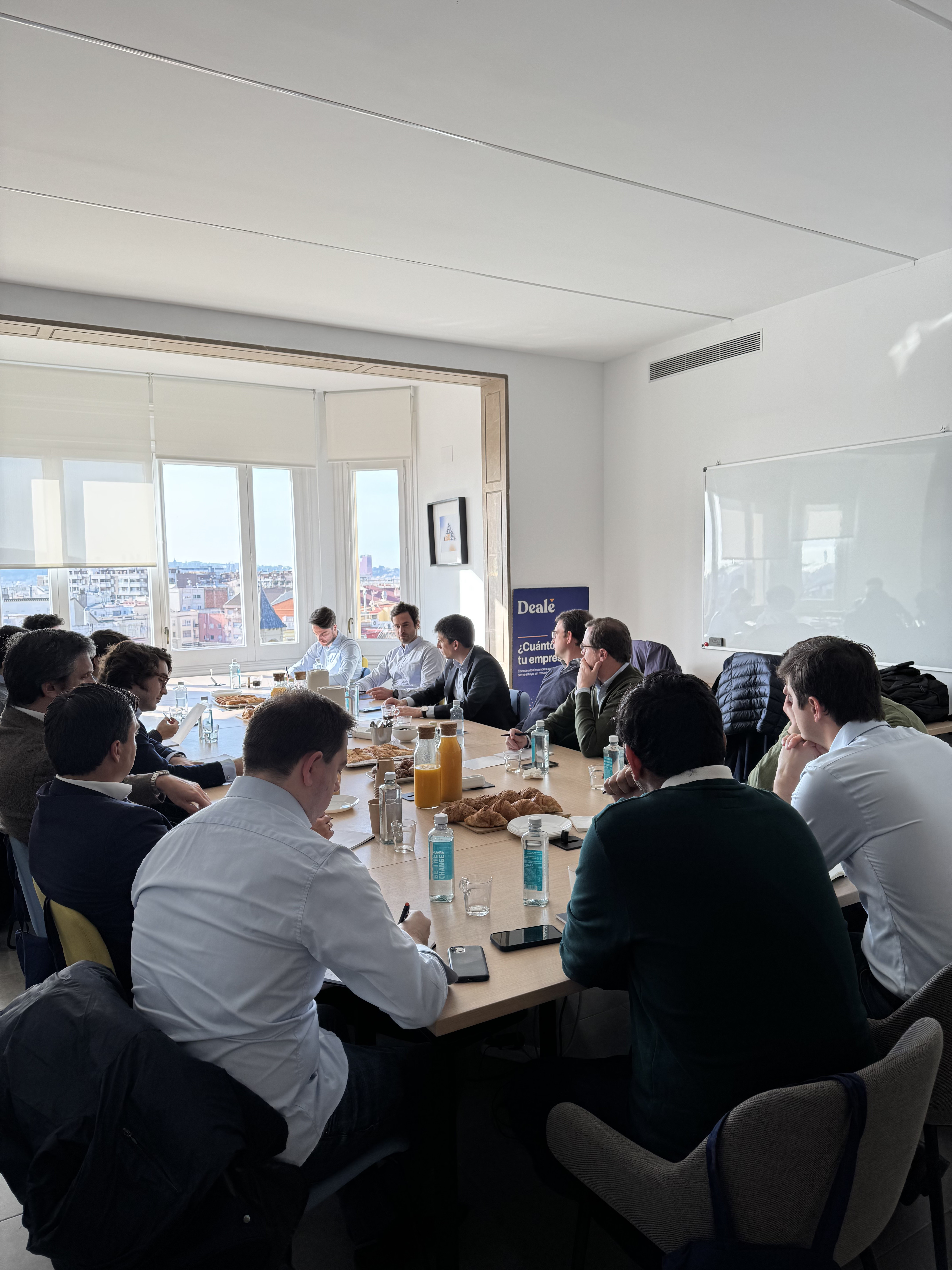
On February 27, we held the first edition of Deale Business Talks at Deale's offices, a forum for sharing experiences, analyzing trends, and discussing the present and future of buying and selling SMEs in Spain.
The session opened with a review of how the M&A market evolved in 2024 and some of the deals Deale facilitated over the year. From there, the conversation turned to the opportunities in the lower mid-market, business consolidation strategies, acquisition financing, and the industries drawing the most interest from buyers.
Date
Organised by

Expectations heading into 2024 were positive for the M&A market. However, the year was shaped by an economic and geopolitical environment that continued to weigh on decision-making. Although the aggregate value of transactions increased, the number of deals remained relatively stable. International uncertainty, the economic slowdown, and tighter access to capital forced both buyers and sellers to be more selective.
On Deale, we saw very different patterns by industry. One of the most striking cases was distribution and wholesale, which went from no letters of intent in the first half to 12 in the second half of the year. Manufacturing also made positive progress, doubling the number of closed deals from 3 to 6 between the first and second halves of the year.
Beyond these two industries, the deals completed during the year showed significant diversification: energy and water, transportation and logistics, education, educational software, publishing, maritime security, healthcare, dental, and agri-food, among others.
One of the main topics of conversation was the appeal of smaller companies. Many of these companies fall off the radar of large private equity funds and some search funds because of their size. However, that doesn't make them less interesting assets — quite the opposite.
Less competition in certain segments of the lower mid-market can make it easier to access good companies at reasonable valuations and create opportunities that would hardly exist in larger processes, where bidding among funds compresses returns. What's more, acquiring an SME doesn't have to be analyzed in isolation: it can be part of a broader strategy of growth, diversification, or consolidation within an industry.
To understand which investor profiles operate in each size range and what they look for, we've published a guide to the types of investors in M&A.
Buy-and-build strategies took up a large part of the conversation. Acquiring small companies to bring them into a larger group makes it possible to gain scale, enter new markets, add capabilities, or consolidate industries that are still highly fragmented.
But completing the acquisition is only the first step. A consolidation strategy also requires the ability to integrate the acquired companies, professionalize certain areas, introduce new processes, and strike a balance between capturing synergies and preserving what made the business work before the deal. The integration model, the former owner's role, and the time needed to consider a company fully integrated are just as important as the purchase price itself.
In companies with high founder dependency, this stage is especially critical: know-how, the customer base, and business relationships may be concentrated in a single person, and the transition needs to be carefully planned so that the value paid doesn't evaporate in the months after closing.
Another trend discussed during the session was financial investors' growing interest in the SME segment. The pressure to deploy capital, generate returns, and strengthen the companies already in their portfolios is driving inorganic growth strategies through add-ons — complementary acquisitions that are integrated into an existing portfolio company.
This opens up opportunities for companies that, because of their size, might not be a direct investment for certain funds but are a perfect fit as a strategic acquisition for one of their portfolio companies. Some of the deals Deale facilitated in 2024 reflected exactly this diversity: from individual investors to strategic buyers, international investors, and funds pursuing consolidation strategies.
Family offices are also playing an increasingly active role in this segment, drawn by the combination of reasonable valuations and long-term investment horizons.
Another lesson from the session was the importance of not analyzing an opportunity solely by the industry it belongs to. Some industries may seem less attractive at first glance or get less attention from investors, yet they're home to companies with strong competitive positions, high profitability, recurring revenue, or significant barriers to entry.
Beyond looking for “trendy industries,” a buyer's analysis always comes down to the specific characteristics of each business: its cash generation capacity, customer concentration, revenue recurrence, owner dependency, competitive positioning, and growth potential. The best opportunities don't always appear where the whole market is looking.
Financing remains one of the biggest constraints on any M&A deal, and in the lower mid-market it comes with additional particularities. During the session, participants discussed the different options available to finance an acquisition, from traditional bank debt to alternative formulas that are steadily gaining ground in Spain.
There was also discussion of the importance of structuring a deal properly to share risks between buyer and seller. Tools such as deferred payments, seller financing, and earn-outs can help close a transaction when there's a gap between the two sides' expectations or uncertainty about how the business will perform. Deal structure thus becomes as important a variable as the valuation itself.
The last part of the conversation was devoted to the outlook for 2025. The scenario pointed toward a more favorable environment for M&A activity, supported by stabilizing interest rates, lower inflation, and better financing conditions.
The main trends identified pointed in three directions. A bigger role for financial investors, driven by the need to deploy capital, rotate portfolios, and keep developing their portfolio companies. The growing impact of artificial intelligence on M&A processes, from identifying opportunities to due diligence, asset valuation, and post-acquisition integration. And M&A strategies more closely tailored to each company's context: some using acquisitions defensively to strengthen their resilience and others adopting more offensive strategies to accelerate their transformation or enter new markets.
The first Deale Business Talk left one idea especially clear: there's a huge number of opportunities in the SME market that remain off the radar of many investors.
A highly fragmented business landscape, generational succession, the emergence of new buyers, and the growing use of consolidation strategies are gradually transforming the Spanish M&A market. Understanding these dynamics, spotting opportunities before the rest of the market, and having the right strategy to finance, execute, and integrate acquisitions will be increasingly decisive.
With Deale Business Talks, we want to keep creating exactly that space: a meeting point where investors, business owners, and industry professionals can share experiences and keep analyzing how business sales are evolving in Spain. If you'd like to learn about the full stages of a business sale in detail, we've published a step-by-step guide.
Don't miss Deale's upcoming events
Get exclusive access to our upcoming events, analysis and conversations about buying and selling companies and M&A for SMEs

