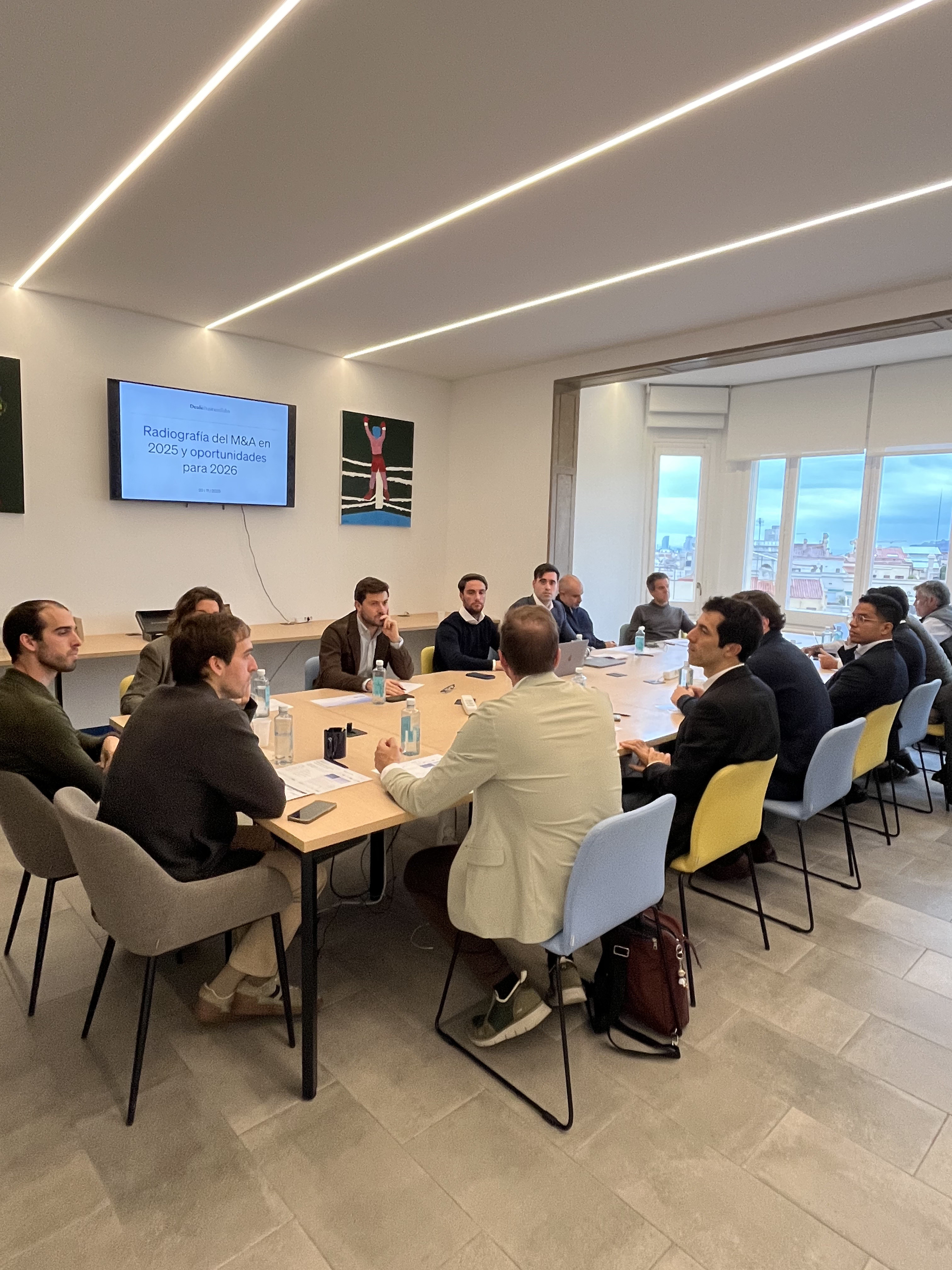
On November 20, we held the third edition of Deale Business Talks, this time focusing on investors and how the market for buying and selling SMEs was evolving.
After two events centered on opportunities in the lower mid-market and how to approach selling a business, this time we wanted to look at the market from the other side of the table: what buyers were looking for, where they were finding opportunities, and how they were structuring their acquisitions.
The session combined data on activity recorded on Deale during 2025 with a panel discussion among investors covering industries, valuations, risks, financing, and the outlook for 2026.
Date
Organised by


Oriol Ferran
Co-Founder and Director at Deale

One of the first items of the event was taking stock of the year. Deale's forecast for 2025 was to close around 30 deals, with an aggregate value of close to €150 million and an average enterprise value of approximately €5 million.
Beyond total volume, the data showed which industries were generating the most interest. Manufacturing topped the ranking with 16 letters of intent (LOIs), followed by distribution and wholesale with 13 and professional, scientific, and technical services with 12. Construction recorded 10 LOIs and communications and technology 9. Further down were industries such as education, hospitality, agriculture, and mining and extraction activities.
The data confirms something that came up repeatedly during the conversation: much of the activity in the lower mid-market is still concentrated in traditional industries — not the ones that grab headlines, but the ones that drive the real economy.
The LOI data also made it possible to analyze who was buying. Family offices led the activity with 27 letters of intent, followed by individual investors with 20 and strategic buyers with 19.
Each profile showed different patterns. Family offices were especially active in manufacturing, distribution, professional services, and construction. Individual investors — typically former executives pursuing entrepreneurship through acquisition — operated in similar industries but with more flexibility to look at smaller companies. Strategic buyers had a particularly strong presence in communications and technology, construction, distribution, and manufacturing.
Search funds showed a preference for companies with recurring revenue, good margins, and fragmented markets, while private equity funds appeared more selectively and generally in deals with higher multiples.
To understand in detail how each buyer profile thinks and what it looks for, we've published a guide to the types of investors in M&A.
One of the session's debates centered on how investment theses are evolving. In recent years, certain tech sectors have captured much of investors' attention. However, the 2025 data showed that activities such as manufacturing, distribution, construction, and professional services still carried significant weight in actual deals.
The conversation raised a question increasingly common among buyers: Is it better to look for seemingly more attractive industries or for excellent companies in less obvious ones? In the lower mid-market, factors such as recurring revenue, margins, market fragmentation, cash generation, and consolidation potential can weigh much more than an industry's apparent appeal.
The 2025 data also showed significant differences in valuations. Among the industries analyzed, arts, entertainment, and recreation had the highest average multiple at 5.92x, followed by agriculture, forestry, and fishing at 5.51x, communications and technology at 5.38x, and fire protection at 5.20x.
Manufacturing stood at 5.13x, distribution and wholesale reached 4.72x, and professional services 4.37x. At the bottom were construction at 3.63x and other services at 3.50x.
These figures reinforce a central idea: talking about a single multiple to value an SME makes little sense. The industry matters, but so do the company's quality, growth, margins, recurring revenue, dependence on the management team, and the level of competition to acquire it. For a closer look at how EBITDA multiples are built by industry and investor type, we've published a detailed analysis with data from the Spanish market.
Beyond the data, the panel discussion explored how acquisition strategies were evolving. Among the questions put to the investors, some stood out: how their ideal target had changed over the last two or three years, whether they were more willing to enter industries new to them, or whether they preferred to keep making add-ons to their existing companies.
The panel also discussed the risks that put buyers off most: excessive concentration in certain customers, technology risk, and key person risk — when a disproportionate share of the company's value depends on a single person. The result is a market where investors are still looking for growth, but where the ability to identify and manage risks increasingly weighs on the final decision.
Another central topic was acquisition financing. Identifying an interesting company, agreeing on a valuation, and getting through due diligence doesn't guarantee a deal will close — the buyer also needs to build a viable financial structure for the acquisition.
That's precisely why, during the event, we introduced Deale Credit, an initiative designed to provide financing for acquisition deals in the lower mid-market. The product offers senior secured financing for acquisitions through leveraged buyout (LBO) structures, with amounts from €100,000 to €300,000 and a four-year term. Its main requirements include a minimum equity contribution equal to 51% of the purchase price.
The goal is to address a common difficulty in smaller deals: finding financing tailored to acquisitions that often fall outside traditional bank products.
Financing a purchase doesn't depend solely on finding a capital provider. It also requires that the acquired company can reasonably support the debt.
The criteria set out for Deale Credit included ratios such as total debt to EBITDA of 3x or less, net debt to EBITDA below 2x, and a minimum DSCR (debt service coverage ratio) of 1.25x. The structure also includes post-acquisition restrictions — limits on dividend distributions, on taking on additional debt, and on certain corporate transactions.
All of this reinforces an important idea: financing an acquisition isn't about maximizing leverage, but about finding a structure that's compatible with the business's cash generation capacity. Deal structure is as important a variable as the valuation itself.
The last part of the event was devoted to looking ahead. Rather than trying to predict which industry will be “the next winner,” the conversation focused on how investment criteria are changing.
Buyers are still interested in established industries and profitable businesses, but they're paying more and more attention to customer concentration, owner dependency, recurrence, quality of management, and how easy the deal is to finance.
Growth through add-ons also keeps gaining ground, especially in fragmented markets where a series of small acquisitions can make it possible to build larger groups. The question for 2026 isn't just which industries will generate the most deals, but which buyers will be able to find the best companies, structure their acquisitions properly, and successfully execute an inorganic growth strategy.
The third Deale Business Talk gave a clear picture of the lower mid-market. Opportunities remain spread across industries. Financial, strategic, and individual buyers coexist in an increasingly professionalized market. And investment decisions now include a deeper analysis of risk, financial structure, and integration capacity.
At Deale, we want to keep contributing to that evolution by providing not only access to investment opportunities, but also the information, tools, and financing needed to turn those opportunities into closed deals.
If you'd like to learn about the full stages of a business sale or understand how an earn-out is structured to help close a transaction, we've published practical guides on both topics.
Don't miss Deale's upcoming events
Get exclusive access to our upcoming events, analysis and conversations about buying and selling companies and M&A for SMEs
